
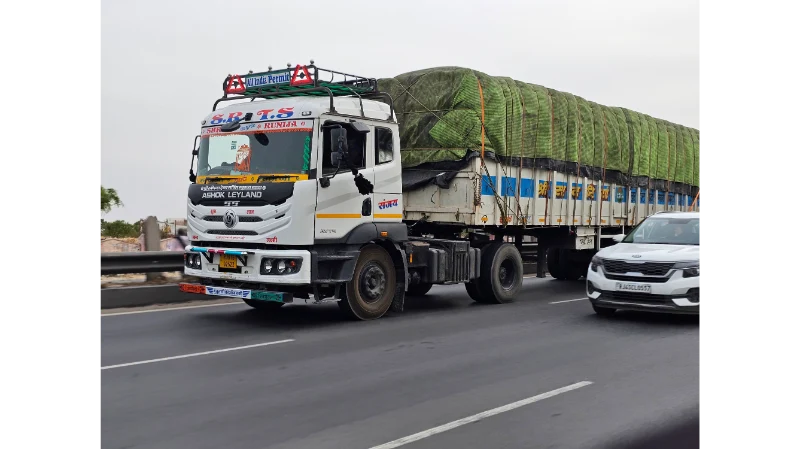
Merging onto a busy highway alongside an 18-wheeler is a terrifying experience for many drivers. You feel the wind shear rock your car, and a massive wall of steel towers over your passenger window. The severe power imbalance on the road becomes instantly clear. Passenger vehicles are entirely at the mercy of commercial truck drivers to safely navigate their massive rigs.
Sadly, many drivers do not realize when they disappear into a truck’s “No-Zone.” Understanding the physics behind these massive blind spots and securing immediate legal intervention are the only ways to fight back against negligent trucking companies after a crash. Commercial carriers have dedicated teams ready to protect their bottom line, and victims need equal aggressive force on their side.
The Anatomy of a Truck’s “No-Zones”
You might wonder why traveling in truck’s no-zone heightens driving risks so significantly. The answer lies in the physical limitations of commercial cabs and their attached trailers. A standard passenger car has a rearview mirror and small side blind spots. A tractor-trailer relies entirely on side mirrors to monitor 53 feet of cargo and multiple lanes of traffic.
The side No-Zones are the most notorious traps for smaller vehicles. Because the driver sits high up in the cab, a passenger car can easily disappear right next to the driver’s door on the left side. On the right side, the blind spot is even larger, running the entire length of the trailer and extending outward across multiple lanes. If you linger in this area, you are completely invisible.
The areas directly in front of and behind the truck are equally dangerous due to their massive scale. According to state safety guidelines, the front No-Zone extends nearly 20 feet ahead of the truck, while the rear No-Zone extends nearly 200 feet from the back. Cutting closely in front of a big rig puts you completely out of the driver’s line of sight over the hood.
To clearly understand these specific danger areas, reference the table below outlining the four No-Zones and their specific threats.
| No-Zone Location | Description of the Blind Spot | Primary Danger |
|---|---|---|
| Front | Extends 20 feet directly in front of the truck cab. | The truck driver cannot see cars cutting in close, leading to severe rear-end collisions. |
| Rear | Extends 200 feet directly behind the trailer. | The truck driver cannot see trailing cars. If the truck stops suddenly, rear underride crashes happen. |
| Left Side | Runs backward from the cab mirror to the mid-trailer. | Faster traffic attempting to pass can be sideswiped if the truck unexpectedly changes lanes. |
| Right Side | Extends from the cab out across multiple lanes. | This is the largest blind spot. Cars are entirely invisible, leading to catastrophic sideswipes. |
The “Vulnerable User” Gap and Crash Physics
When a collision happens between a commercial truck and a passenger car, the occupants of the smaller vehicle face an extreme statistical and physical disadvantage. Safety experts call this the “Vulnerable User” gap. A fully loaded semi-truck legally weighs up to 80,000 pounds. A standard passenger sedan weighs roughly 4,000 pounds.
This extreme weight disparity means the smaller vehicle absorbs almost all the kinetic energy during an impact. State highway safety data emphasizes this physical power imbalance, noting that in crashes involving large trucks, passenger vehicle occupants sustain 78 percent of fatalities. The massive steel frame of the truck easily crushes the smaller car’s crumple zones.
When a passenger vehicle is caught in one of these massive blind spots, the resulting collision is rarely a minor fender bender. The weight disparity alone means occupants of the smaller vehicle absorb the full force of the impact, often walking away with life-changing injuries or not walking away at all. Victims of these crashes deserve answers about more than just the driver’s actions that day, and commercial vehicle accident lawyers are the people equipped to find those answers, whether the trail leads to a company’s hiring decisions, a fleet’s maintenance failures, or federal safety violations that were ignored long before the crash happened.
The Critical 48-Hour Legal Window
The days immediately following a crash are a legal battleground, not a time for passive waiting. Within minutes of a severe accident, the trucking company will dispatch its own rapid response team. These corporate investigators, insurance adjusters, and defense attorneys arrive at the scene to minimize the motor carrier’s financial liability.
This makes the first 48 hours absolutely critical for victims. You need an opposing “Rapid Response” legal team to take control of the crash site. Crucial evidence disappears quickly. Skid marks wash away in the rain, damaged vehicles are moved to impound lots, and debris is swept off the highway. Once the physical evidence is gone, proving liability becomes incredibly difficult.
To fight back, specialized crash attorneys use forensic scene mapping. Accident reconstruction experts deploy 3D laser scanning to capture millions of data points across the roadway. This creates a highly accurate digital twin of the crash site that proves exact sightlines, blind spot overlap, and precise vehicle crush profiles.
Aggressive Tactics to Protect Your Evidence
Trucking companies control the truck, which means they control the most vital evidence. A lawyer must use specific legal tools to stop the motor carrier from destroying, altering, or hiding critical crash data. The first step is issuing a “Letter of Spoliation.” This is an immediate legal demand that legally forbids the trucking company from altering or destroying the truck and its records.
Sometimes, a letter isn’t enough to stop a negligent company. Attorneys will frequently file Temporary Restraining Orders (TROs) with a judge. A TRO acts as a strict legal injunction to halt any unauthorized repairs to the commercial vehicle. Repairing a damaged bumper or replacing a faulty air brake system before independent inspection is a classic tactic used to hide maintenance failures.
When companies refuse to hand over information, attorneys escalate the fight. They file Motions to Compel, forcing the motor carrier to hand over the truck’s Electronic Control Module (ECM) and dashcam footage. The ECM acts as the truck’s “Black Box,” recording the truck’s exact speed, hard braking events, and engine RPMs in the seconds right before the crash.
Conclusion: Taking Control After a No-Zone Crash
Surviving a crash in a commercial truck’s No-Zone is physically and emotionally devastating. The extreme weight disparities and limited visibility create catastrophic impacts that forever alter victims’ lives. However, the fight for accountability and financial recovery is not a battle you have to face alone.
Understanding the severe physics of the Vulnerable User gap is only the first step. The real difference in your recovery comes down to immediate action. The critical need for a rapid 48-hour response cannot be overstated, as early intervention secures vital crash data. Furthermore, leveraging federal FMCSR laws gives victims the power to defeat corporate defenses and hold wealthy trucking companies accountable.